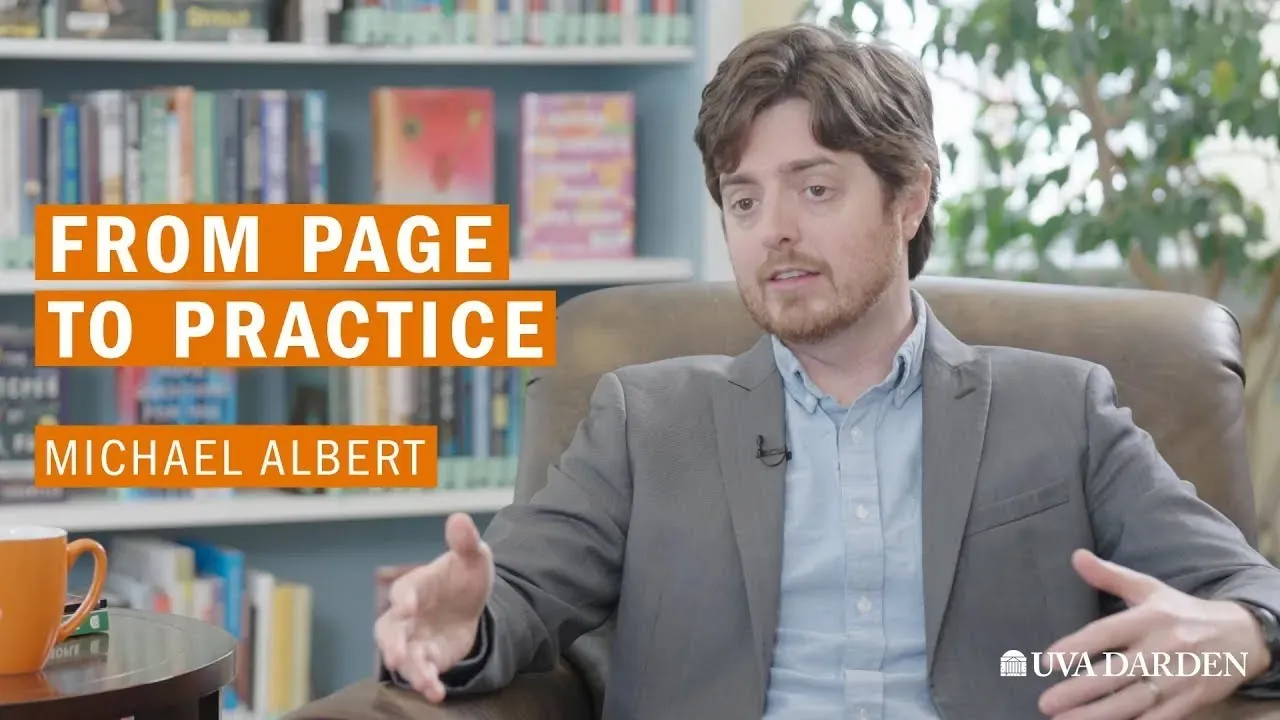
From Page to Practice
Assistant Professor of Business Administration Michael Albert discusses three cases for which students use Python code and Jupyter Notebooks in his course elective, “Machine Learning and AI in Business.

Michael Albert
Assistant Professor of Business Administration


Transcript
(bright music)
- Today I'm here with Professor Michael Albert,
who teaches in our data analytics and decision sciences area
at the Darden School.
Michael, you have a course called
Machine Learning in Artificial Intelligence and Business,
and you have several cases
that kind of form a course module, if you will,
that build on one another in difficulty.
Let's talk a little bit about each of these.
Just briefly give a synopsis for us
of University of Virginia Hospital
predicting patient discharge?
- Yeah, so this is an interesting case.
It sets up this problem of
how can the UVA hospital system use beds more efficiently
by incorporating some predictive analytics?
The great thing about this case
is that it has a pretty interesting data set.
It's one we worked with UVA hospital to collect,
it's about 700 columns, a lot of rows.
And so it's structured data,
but it starts to have flavors of unstructured data.
The columns are not interpretable by the students,
so they really have to work with kind of machine learning,
you know, big data kind of techniques,
and it lets them to build these predictive models
that can then be used in a clear decision making problem
on when to start kind of doing
some of the proactive discharge steps,
maybe even before the doctor officially
makes a discharge decision.
- So one of the things that you do with students
is you actually have them use artificial intelligence
and large language models to help them in their programming.
- That's right. So the class is based in Python.
So we use Python as a tool
to facilitate all of the analysis.
We provide as part of the cases,
starter code that's, you know,
this comprehensive document
that the instructor can take and modify for the students
to kind of increase or decrease the level of difficulty
for the programming part.
In the MBA course,
I provide a lot of the code for them
and they tweak around the margins a lot of times.
In addition, I provide a coding assistant
as part of kind of the resources in which they program.
And these coding assistants
are large language model-based coding assistants
that really help kind of non-technical, you know,
students engage with these kind of,
these technical tools like programming in Python.
- So those are resources that are available
to instructors as well?
- Yes. I mean they're things that I provide
as part of the case package. Yes.
- So building off of the learning there,
we have a case called Kibet Capital.
Can you tell us a little bit about
what advances in students learning in this case?
- Yeah, so it's a nice follow up
to the hospital discharge case
in that Kibet capital moves from, you know,
structured data that we have in the hospital discharge case
To unstructured data.
Particularly we're working with images.
The problem is we have a local magazine
that is interested in trying to figure out, you know,
what is the representation of the ads in their magazine.
And they have magazines going back, you know,
a couple decades at this point,
and they wanna understand
how representation has changed over time.
So we use computer vision techniques
to work with this unstructured data of these images
in order to build predictive models to determine
whether or not, you know, the people in their ads
are representative of the communities
in which these magazines are published.
- What I love about this case is
there's sometimes an ethical component
that students discover
because they're analyzing demographics-
- That's right. - Based on computer image.
- That's right. I mean, so
the students get some exposure
to how these kind of computer vision techniques work
and more importantly, maybe don't work a lot of times.
And so understanding how when we're using these, you know,
kinds of advanced tools to,
especially to measure or to, you know,
affect decisions for, you know,
protected attributes like race or gender
can be, you know, very sensitive.
And this often comes out in the discussion.
- And the third case that kind of rounds out this module
is a topic that students are gonna be very familiar with,
and that's coffee and Yelp reviews.
What can you tell us about Case Study coffee?
- Yeah, so in this progression
we've moved from structured data that's wide
to unstructured data and images
and now the next step is text.
And so the goal of this case
is to get students to analyze Yelp reviews
for this coffee shop in Portland called Case Study Coffee.
And they used large language models
and various advanced natural language processing techniques
to build predictive models
to evaluate whether or not these Yelp reviews are useful.
And so it gets students kind of experienced
with these cutting edge, you know, NLP techniques.
They get their hands dirty. It's a really fun case.
- Thanks for taking the time to share with us today
some information about some of these cases
that are used in your advanced data analytics scores.
- Great. - [Elliot] I've really
enjoyed it. - I have too. Thank you.
- If you'd like to preview any of these cases
written by Professor Albert
or download any of the teaching notes for them,
visit us today at dardenbusinesspublishing.com.